

Quantum science and technology
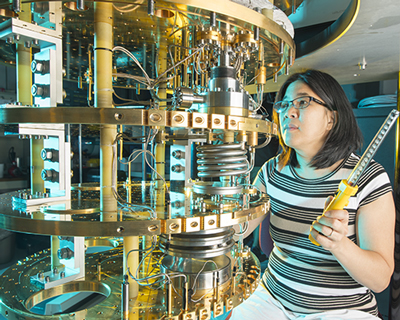
Fermilab is a leading institution in the advancement of quantum information science. Through cutting-edge research, technology development and strategic partnerships, Fermilab researchers connect fundamental physics with practical and impactful applications.
The laboratory pioneers superconducting quantum computing technologies and quantum networks, and sensors. Leveraging its world-class expertise and facilities, Fermilab accelerates progress across the quantum ecosystem.
Fermilab is advancing next-generation quantum technologies through concerted programs such as the Superconducting Quantum Materials and Systems (SQMS)—a DOE National Quantum Information Science Research Center (NQISRC)—and research in theory, quantum computing, networking, and sensing.
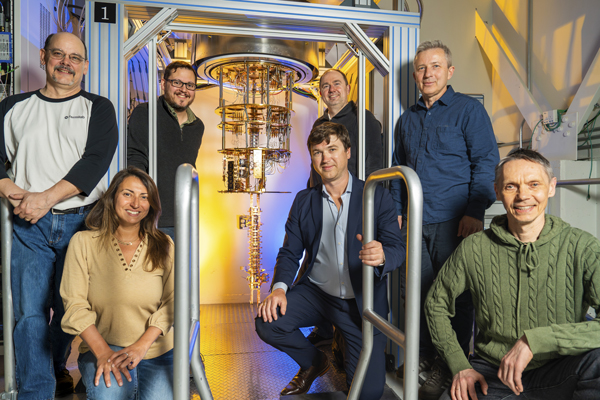
Superconducting Quantum Materials and Systems Center
The SQMS Center at Fermilab leads a national and international collaboration to advance the science and engineering of quantum computing, sensing and communication. As one of the U.S. Department of Energy's National Quantum Information Science Research Centers, SQMS brings together more than 40 partners from national laboratories, universities and industry to tackle some of the most challenging problems in quantum technology.
Building on Fermilab's world-leading expertise in superconducting materials, radio-frequency cavities and large-scale cryogenics, the Center is developing ultra-high-coherence quantum devices and scalable architectures that will power the next generation of quantum applications. SQMS researchers are pursuing novel computation approaches, pioneering advanced quantum sensors for fundamental physics experiments and working toward the long-term goal of robust, interconnected quantum systems.
Learn more about the SQMS Center.
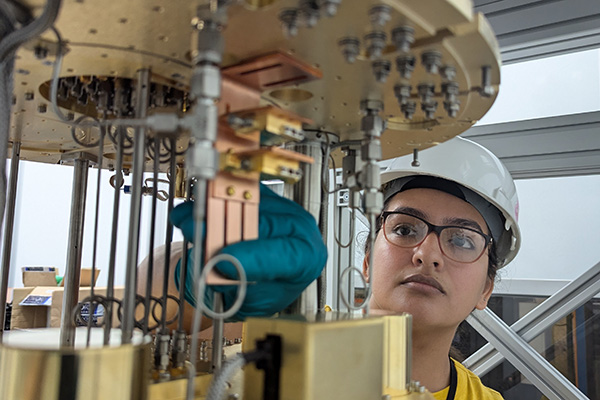
Emerging quantum technologies
Fermilab scientists and engineers are advancing quantum information science through research and development in quantum sensing, superconducting technology, electronics and control systems, quantum networking, and quantum theory and algorithms.
They are using innovative techniques, such as microwave single-photon sensing, to detect dark matter, while also improving quantum networks and qubit control with new tools and approaches that make these systems more scalable and robust.
They are also developing powerful optimization algorithms to solve complex problems in particle physics and exploring how quantum science connects to quantum field theory, which helps improve quantum simulations and computational efficiency. These innovations are shaping the future of quantum science and technology, and compel discoveries in particle physics and beyond.
Learn more about emerging quantum technologies at Fermilab.

Quantum theory
Theorists in Fermilab's Quantum Theory Department are harnessing the unique capabilities of quantum information science to answer fundamental questions about the universe, and to address computational challenges in high-energy physics and other areas of the physics. They are developing innovative methods to simulate quantum field theories, which describe how subatomic particles behave and interact.
They are proposing novel ways to use quantum sensing to explore the universe and test theories involving new particles, dark matter, gravitational waves and other phenomena beyond the Standard Model. They are also investigating the role of quantum entanglement in building particle physics models and enabling new capabilities in sensing and computing, such as error correction and superradiance.
Learn more about Fermilab's quantum theory.
- Last modified
- 12/03/25
- email Fermilab