Fermi National Laboratory


Tevatron sets all-time luminosity record of 30.2 E30


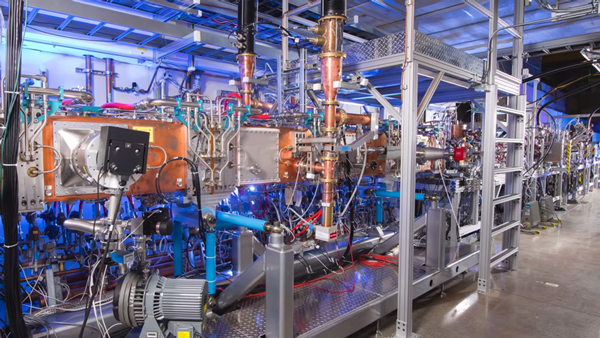
In the early morning of Tuesday, Sept. 24, beam experts at Fermilab pushed the performance of the Tevatron accelerator to an all-time high. The Tevatron, the world’s most powerful particle accelerator, achieved a peak luminosity of 30.2 E30 inverse square centimeters per second, a measure for the collision rate of protons and antiprotons inside the accelerator tunnel. Scientists are eager to increase luminosity and hence to produce more collisions, increasing the chance of observing new particle reactions involving quarks and other fundamental building blocks of matter.

This all-time luminosity record follows a record breaking weekend for the Tevatron. On Saturday, Sept. 21, at 09:05 a.m., Fermilab accelerator experts achieved a luminosity of 28.5 E30 inverse square centimeters per second. Two subsequent stores of protons and antiprotons, on Sunday at 7:40 a.m. and on Monday at 3:30 a.m., almost broke the brandnew record, achieving luminosities of 27.6 E30 and 28.1 E30, respectively. Before the weekend, the all-time Tevatron luminosity record was at 26.4 E30. The Run I record, achieved in 1995, is at 25.0 E30.


In addition to setting a new record for the collision rate, physicists also set a new Run II record for the total number of collisions produced during a single week. For the week ending Sunday night, Tevatron experts set a Run II record for the weekly integrated luminosity of 4.8 inverse picobarns (pb-1), close to the Run I record of 4.9 pb-1.


Operators of Fermilab’s Antiproton Source also set new records over the weekend. On Sunday morning they achieved an antiproton production rate of 12.1 milliamps per hour, leading to the production of approximately 120 billion antiprotons in an hour. This production record was improved on early Monday morning, when experts achieved a stacking rate of 12.4 milliamps.


Producing a large number of antiprotons is crucial to achieving higher levels of luminosity. In the near future, Fermilab scientists aim to achieve a luminosity of 40 E30 and a weekly integrated luminosity of 7 pb-1.


For more information on the Tevatron’s performance, please check www.fnal.gov/pub/now/index.html.


last modified 9/24/2002   email Fermilab
Security, Privacy, LegalFermi National Accelerator Laboratory