



Project website:
www.darkenergysurvey.org
Fact Sheet:
http://news.fnal.gov/wp-content/uploads/understanding-dark-energy.pdf
Eight billion years ago, rays of light from distant galaxies began their long journey to Earth. That ancient starlight has now found its way to a mountaintop in Chile, where the newly constructed Dark Energy Camera, the most powerful sky-mapping machine ever created, has captured and recorded it for the first time.
That light may hold within it the answer to one of the biggest mysteries in physics – why the expansion of the universe is speeding up.
Scientists in the international Dark Energy Survey collaboration announced this week that the Dark Energy Camera, the product of eight years of planning and construction by scientists, engineers, and technicians on three continents, has achieved first light. The first pictures of the southern sky were taken by the 570-megapixel camera on Sept. 12.
“The achievement of first light through the Dark Energy Camera begins a significant new era in our exploration of the cosmic frontier,” said James Siegrist, associate director of science for high energy physics with the U.S. Department of Energy. “The results of this survey will bring us closer to understanding the mystery of dark energy, and what it means for the universe.”
The Dark Energy Camera was constructed at the U.S. Department of Energy’s (DOE) Fermi National Accelerator Laboratory in Batavia, Illinois, and mounted on the Victor M. Blanco telescope at the National Science Foundation’s Cerro Tololo Inter-American Observatory (CTIO) in Chile, which is the southern branch of the U.S. National Optical Astronomy Observatory (NOAO). With this device, roughly the size of a phone booth, astronomers and physicists will probe the mystery of dark energy, the force they believe is causing the universe to expand faster and faster.
“The Dark Energy Survey will help us understand why the expansion of the universe is accelerating, rather than slowing due to gravity,” said Brenna Flaugher, project manager and scientist at Fermilab. “It is extremely satisfying to see the efforts of all the people involved in this project finally come together.”
The Dark Energy Camera is the most powerful survey instrument of its kind, able to see light from over 100,000 galaxies up to 8 billion light years away in each snapshot. The camera’s array of 62 charged-coupled devices has an unprecedented sensitivity to very red light, and along with the Blanco telescope’s large light-gathering mirror (which spans 13 feet across), will allow scientists from around the world to pursue investigations ranging from studies of asteroids in our own Solar System to the understanding of the origins and the fate of the universe.
“We’re very excited to bring the Dark Energy Camera online and make it available for the astronomical community through NOAO’s open access telescope allocation,” said Chris Smith, director of the Cerro-Tololo Inter-American Observatory. “With it, we provide astronomers from all over the world a powerful new tool to explore the outstanding questions of our time, perhaps the most pressing of which is the nature of dark energy.”
Scientists in the Dark Energy Survey collaboration will use the new camera to carry out the largest galaxy survey ever undertaken, and will use that data to carry out four probes of dark energy, studying galaxy clusters, supernovae, the large-scale clumping of galaxies and weak gravitational lensing. This will be the first time all four of these methods will be possible in a single experiment.
The Dark Energy Survey is expected to begin in December, after the camera is fully tested, and will take advantage of the excellent atmospheric conditions in the Chilean Andes to deliver pictures with the sharpest resolution seen in such a wide-field astronomy survey. In just its first few nights of testing, the camera has already delivered images with excellent and nearly uniform spatial resolution.
Over five years, the survey will create detailed color images of one-eighth of the sky, or 5,000 square degrees, to discover and measure 300 million galaxies, 100,000 galaxy clusters and 4,000 supernovae.
The Dark Energy Survey is supported by funding from the U.S. Department of Energy; the National Science Foundation; funding agencies in the United Kingdom, Spain, Brazil, Germany and Switzerland; and the participating DES institutions.
More information about the Dark Energy Survey, including the list of participating institutions, is available at the project website: www.darkenergysurvey.org.
For a summary of the major components contributed to the Dark Energy Camera by the participating institutions, read these symmetry articles: www.symmetrymagazine.org/cms/?pid=1000880, http://www.symmetrymagazine.org/article/september-2012/the-dark-energy-camera-opens-its-eyes
Released by Fermilab and the National Optical Astronomy Observatory (NOAO) on behalf of the Dark Energy Survey collaboration. NOAO is operated by the Association of Universities for Research in Astronomy (AURA), Inc. under cooperative agreement with the National Science Foundation.
Fermilab is America’s premier national laboratory for particle physics research. A U.S. Department of Energy Office of Science laboratory, Fermilab is located near Chicago, Illinois, and operated under contract by the Fermi Research Alliance, LLC. Visit Fermilab’s website at www.fnal.gov and follow us on Twitter at @FermilabToday.
The DOE Office of Science is the single largest supporter of basic research in the physical sciences in the United States, and is working to address some of the most pressing challenges of our time. For more information, please visit science.energy.gov.
-
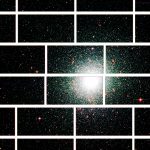
- Zoomed-in image from the Dark Energy Camera of the center of the globular star cluster 47 Tucanae, which lies about 17,000 light years from Earth. Credit: Dark Energy Survey Collaboration
-
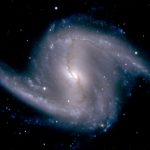
- Zoomed-in image from the Dark Energy Camera of the barred spiral galaxy NGC 1365, in the Fornax cluster of galaxies, which lies about 60 million light years from Earth. Credit: Dark Energy Survey Collaboration
-
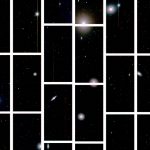
- Zoomed-in image from the Dark Energy Camera of the Fornax cluster of galaxies, which lies about 60 million light years from Earth. Credit: Dark Energy Survey Collaboration
-

- Full Dark Energy Camera composite image of the globular star cluster 47 Tucanae, which lies about 17,000 light years from Earth. Credit: Dark Energy Survey Collaboration
-
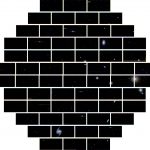
- Full Dark Energy Camera image of the Fornax cluster of galaxies, which lies about 60 million light years from Earth. The center of the cluster is the clump of galaxies in the upper portion of the image. The prominent galaxy in the lower right of the image is the barred spiral galaxy NGC 1365. Credit: Dark Energy Survey Collaboration
-
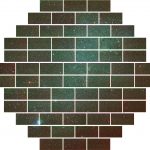
- Full Dark Energy Camera composite image of the Small Magellanic Cloud (a band of greenish stars running from lower left toupper right), a dwarf galaxy that lies about 200,000 light years from Earth, and is a satellite of our Milky Way galaxy. Credit: Dark Energy Survey Collaboration
-
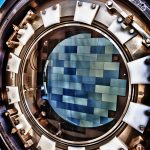
- The Dark Energy Camera features 62 charged-coupled devices (CCDs), which record a total of 570 megapixels per snapshot. Credit: Fermilab
-
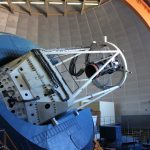
- The Dark Energy Camera, mounted on the Blanco telescope in Chile. Credit: Dark Energy Survey Collaboration
-
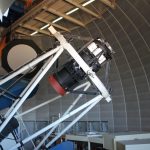
- The Dark Energy Camera, mounted on the Blanco telescope in Chile. Credit: Dark Energy Survey Collaboration
-
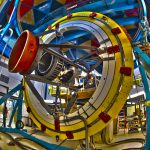
- Dark Energy Camera telescope simulator at Fermilab. Credit: Fermilab
-
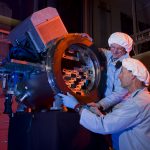
- Scientists build a prototype of the Dark Energy Camera, which will survey about one-tenth of the sky to measure 300 million galaxies and discover thousands of supernovae. Credit: Fermilab
-
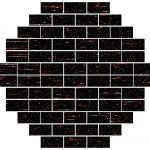
- A simulation of a photo of galaxy clusters taken by the Dark Energy Camera. A single camera image captures an area 20 times the size of the moon as seen from Earth. Credit: Dark Energy Survey Collaboration
-
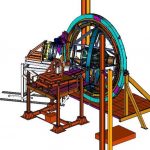
- An artist’s rendering of the Dark Energy Camera inside the frame that supports the camera in the Blanco telescope. Credit: Fermilab/Dark Energy Survey Collaboration
-
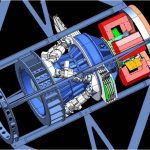
- An artist’s rendering of the 570-megapixel Dark Energy Camera. Credit: Fermilab/DES collaboration
-
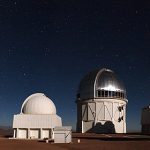
- The Blanco telescope in Chile as seen at nighttime. Credit: T. Abbott and NOAO/AURA/NSF
-
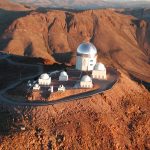
- The Blanco telescope in Chile as seen from the air. Credit: NOAO/AURA/NSF
-
- The Blanco telescope in Chile. Credit: T. Abbott and NOAO/AURA/NSF
-
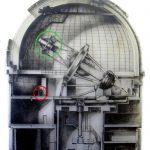
- The 4 meter Blanco telescope. The green circle marks the location of the prime focus cage where the Dark Energy Camera will be mounted. Credit: CTIO/AURA/NSF
To download the first images captured by the Dark Energy Camera, go to http://www.noao.edu/news/2012/pr1204.php